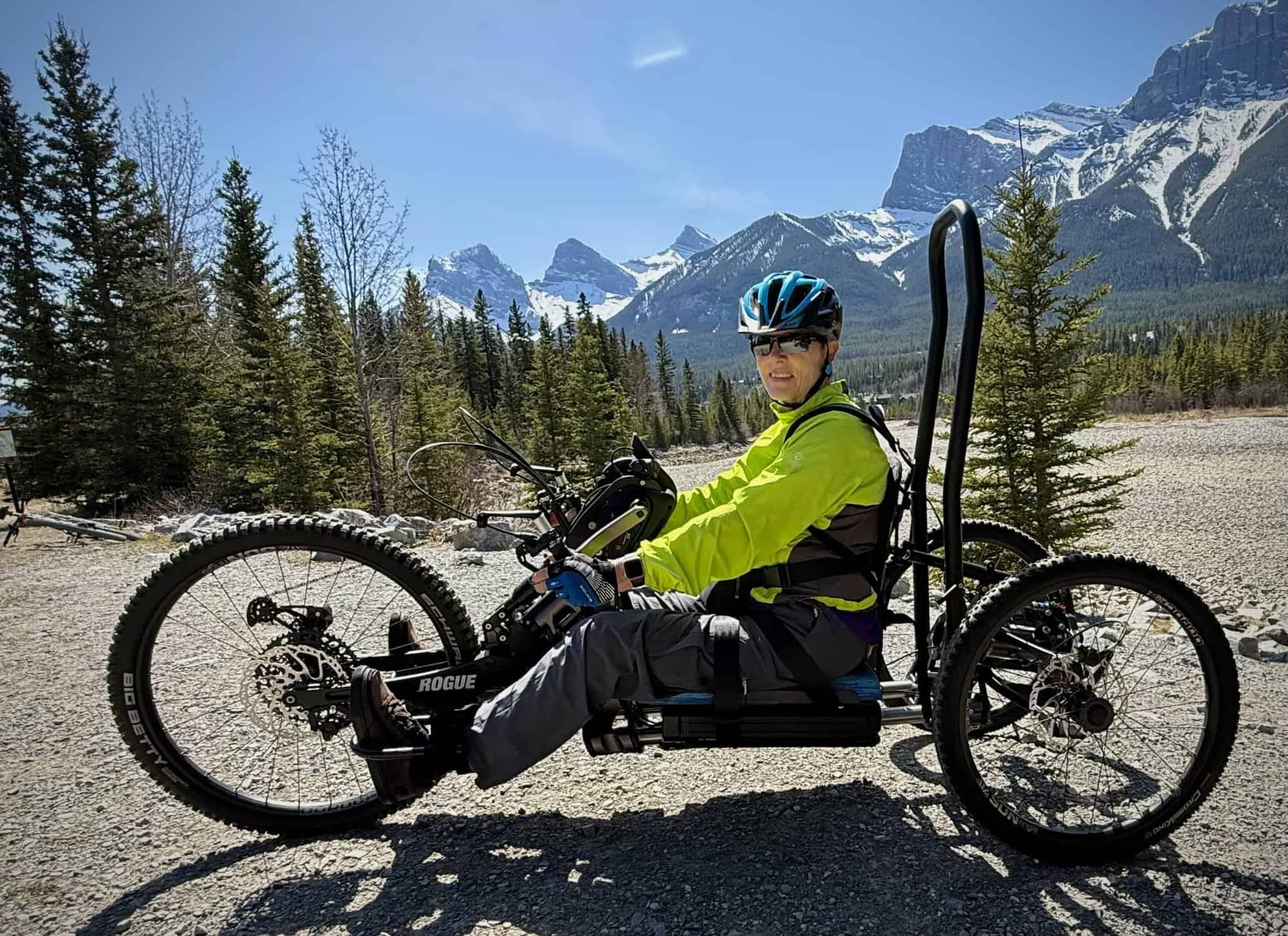
Athlete #905 Patricia Fonstad Arcade Belt Goal: I will be able to ride the Trans Canada Trail (aka The Legacy Trail) from Canmore to Banff townsite and back
There are many different stages of enjoyment that come through both our High Fives Empowerment Fund and Arcade Belt Goal program, and they are closely intertwined. It begins with the initial excitement of reading an athlete’s application and knowing that we will be able to help them fund their goals and dreams. Once an athlete receives a grant—which is always a thrilling moment—they are asked to create a goal that the equipment or grant we provide will help them achieve.
Blog written by Athlete Patricia Fonstad
I became paraplegic in May of 2023, at the age of 69. At the time of my accident, I was still a licensed and clinically active physiotherapist. I was also an avid hiker, skier and cyclist. I was injured on a beautiful spring while I was skiing at the local ski hill where I had been skiing for 50 years. The sun was making the snow very sticky and soft, especially on the flatter terrain. My companions and I were at the top of the mountain having a wonderful time but decided to call it a day because it was starting to get too soft and very sticky on some parts of the run. We knew that the bottom of the run would be even tougher because it had had sun and warm temperatures for a longer time. I was a stone’s throw away from the bottom when I encountered a particularly flat section of the run which was stickier than the rest. I was navigating myself very slowly across the run towards a stand of small trees, hoping to find cooler snow and better conditions when my right ski broke through the soft snow and started pulling me towards a small stand of trees and bushes. I knew I was going to fall but had no concerns about it because there was very little pitch and I was going very slowly. I expected to flop over and then get up and ski the rest of the way down. My last thought before I woke up on my back in excruciating pain was that I was being sucked towards the trees. I already suspected (but did not want to believe) when I came to that I had no motor power in my legs. I remember thinking “please God, not for the rest of my life!”
I was in and out of consciousness the whole time that I was being extracted from the trees and loaded onto the ski patroller’s toboggan. I have very little memory of the ambulance ride to the hospital. Once at the hospital a CT scan confirmed a fracture of the T5 vertebra with compromise of the spinal cord, as well as a collapsed right lung. The level of my injury is T3 because a few of the fracture fragments migrated upwards in the spinal canalcausing cord damage at T3. This means that I am paralyzed from the middle of my breastbone down.
As a physiotherapist, I knew the consequences and likely outcome of a T3 spinal cord injury. I did not want to live the rest of my life as a paraplegic and asked my husband to let the hospital staff in ICU stop trying to save my life! Clearly that did not happen.
In the early days on the trauma unit, I used to look at my legs, that were still very muscular and think about all the miles they had served me while skiing, hiking, and cycling. It was devastating to imagine a life without the use of my legs. All the outdoor activities that gave me joy, cleared my head, and kept me fit were gone in an instant. My career was also taken away from me on the day of my injury. When I was well enough and could perform certain physical tasks, I was transferred to the rehab ward. One day the recreational therapist organized for a company called Bowhead Corp to bring three models of adaptive bikes to the hospital so that staff and patients could see and hear about the bikes. There was also an opportunity to try riding them. I decided to try riding one. I was unable to make a full revolution of the hand pedals because my balance was poor and I was lacking the appropriate strength in my upper back, but it gave me a taste of what might be possible in the future. From that day onwards, I wanted an adaptive bike. It gave me a goaland some hope for the future amid my devastating loss and knowing there was a low chance of recovery.
My first year was one of constant changes and adaptations, most of them were sad for me because they meant that my paralysis was permanent and that I needed to come to terms with it. It also meant that most of my house was not accessible to me. Large portions of the community that I live in were also not accessibleto a wheelchair. The rehabilitation process was intense and there were months of hard work. There was still a lot more work to be done when I was discharged. The process was overwhelming and devastating at the same time. Each day was like the day before and predictive of the days ahead. There was little to look forward to, and very little joy. All I could see were my losses and I could not envision many possibilities.
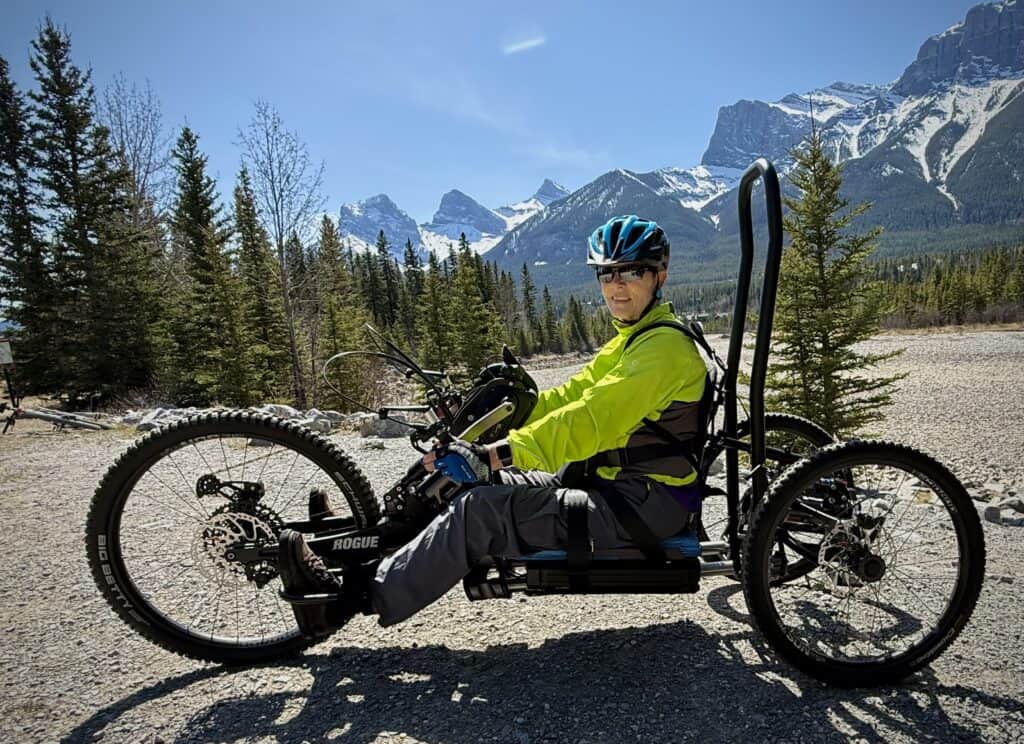
The first spring after my accident I attended a sports camp for disabled women that was organized through Rocky Mountain Adaptive Sports (RMA) in Canmore, Alberta. They introduced me to a variety of sports that were possible for me. My favorite activity was bike riding. I was able to try the same three modelsof adaptive bikes that I had been introduced to before. During the summer of 2024 I took more cycling lessons from RMA and once again tried all the available models with an eye to choosing the most appropriate model for my lifestyle. I settled on the Bowhead Rogue, which is capable of some trail riding but also suitable for paved paths and road biking.
Early in 2025 I applied to the High Fives Foundation for a grant to help me fund the purchase of the Rogue. The application process was eye opening because it made me reflect on what my rehab goals were and how I was going to obtain them. I also had to write how I planned to use the grant, if I was awarded one, and how the grant would help me achieve my rehab goals. They also asked me to set a very specific lifestyle goal and give it a projected date of achievement. Just the application process helped me think of more positive things and I started seeing possibilities not just barriers.
I was fortunate and honored to be awarded a grant from the High Five’s empowerment fund to go towards the Rogue handcycle bike that I had ordered.
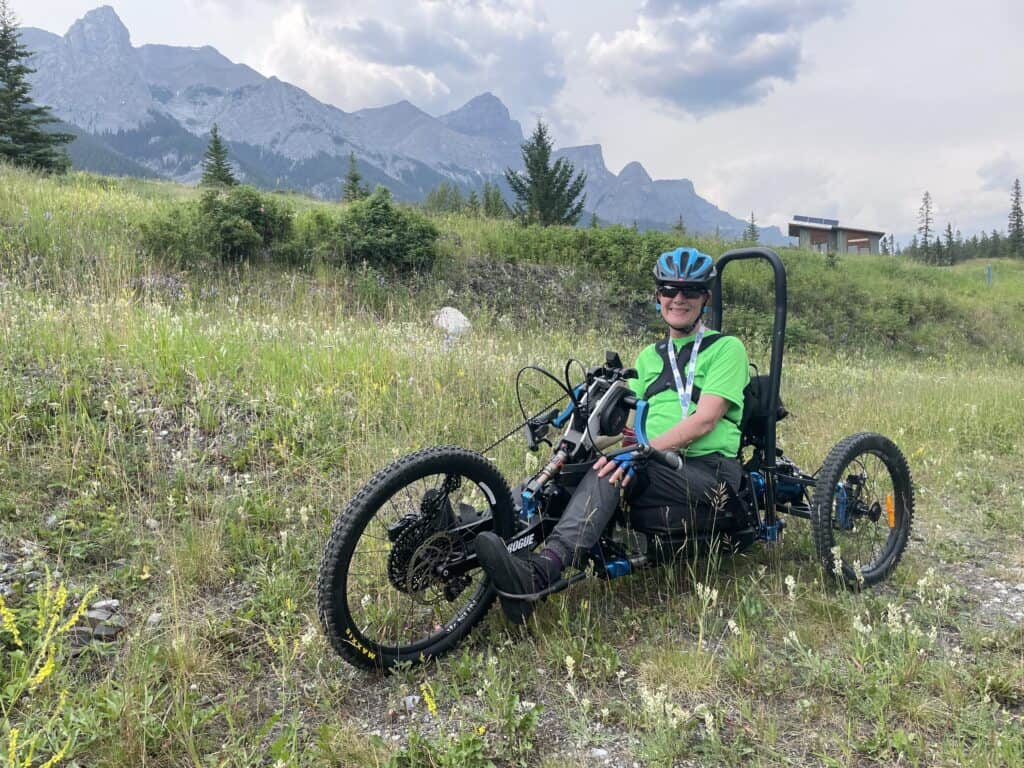
The bike arrived in April 2025. Words are not enough to express the feeling of joy and freedom of riding a bike again. I loved everything about it. I loved the sun and the wind on my face. I loved the feeling of exercising, and I even enjoyed the workload of climbing hills again and the exhilarating feeling of success when I got to the top of the hill.
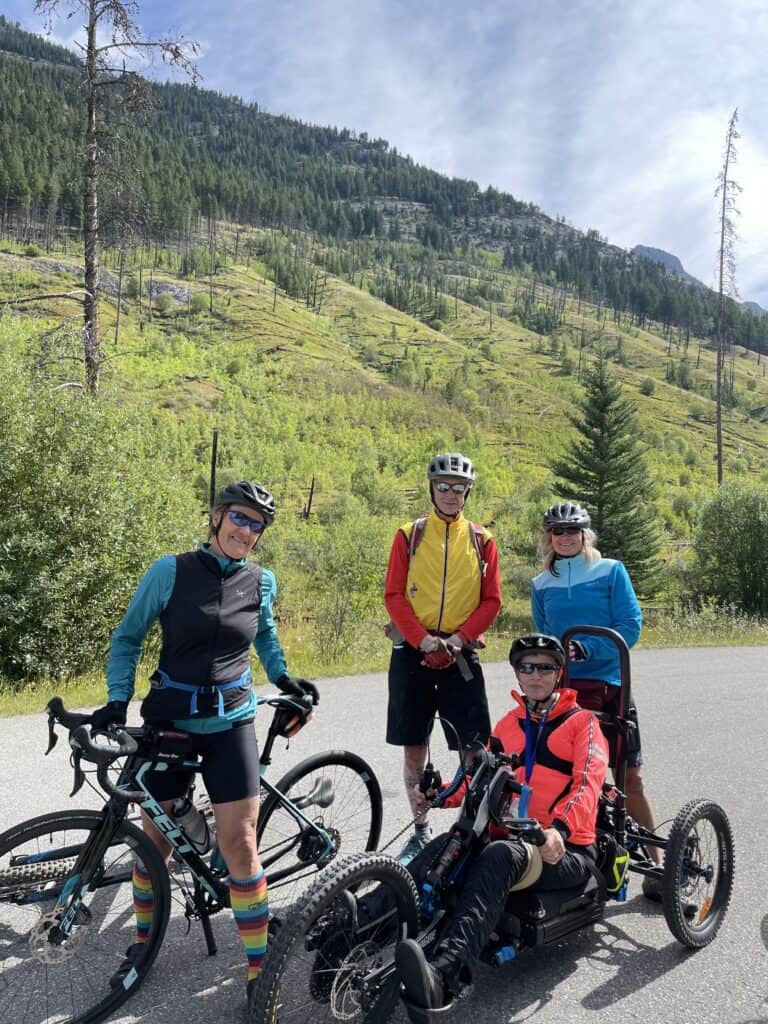
The goal that I set for myself was to be able to cycle from Canmore to Banff on the Legacy Trail (part of the Trans Canada Trail) by the end of August 2025. I missed that date by 10 days, but it was more a lack of opportunity than a lack of ability. Cycling to Banff was a weekly occurrence for my husband and me. We loved to cycle to Banff and stop for coffee and then cycle home to Canmore. It felt like I got a little of my life and myself back when I did that ride for the first time. It was 44 km round trip and whereas that was an easy ride for us before my accident, it was a significant accomplishment for me as a paraplegic. High Fives contacted me in August to see if I had accomplished my goal and held me accountable for reaching that goal. I felt supported and encouraged rather than pressured to perform.
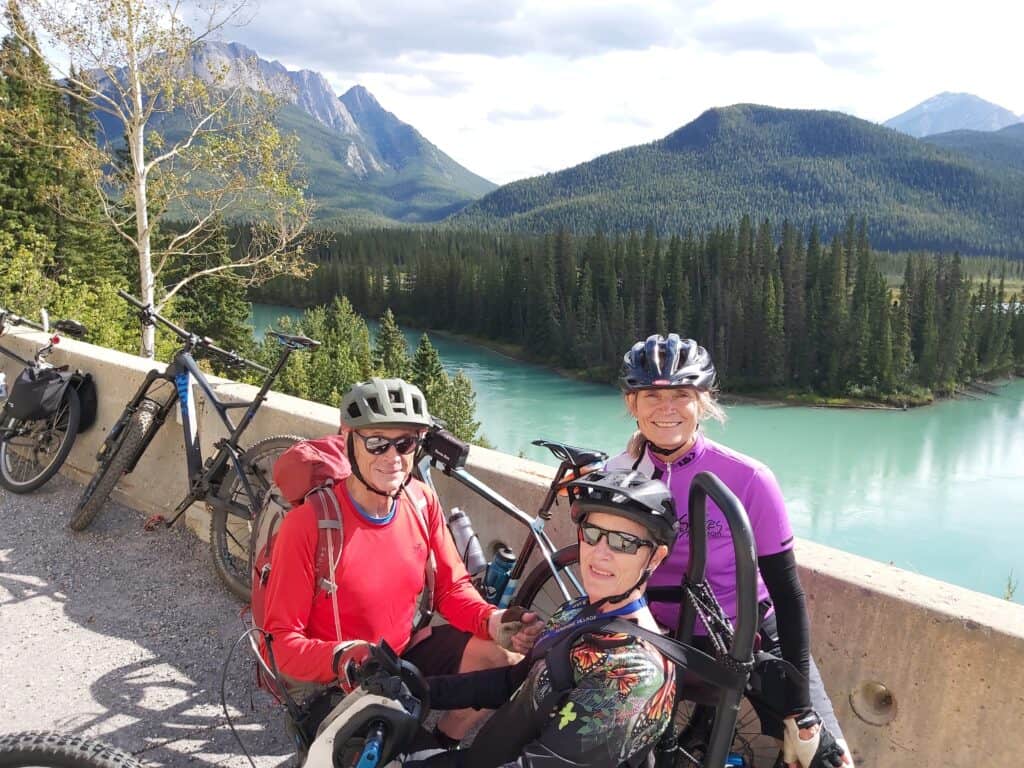
Now I am setting new goals for the future and am deeply grateful to the High Fives Foundation for the experience of the reflective application process and for the monetary assistance to purchase my bike.
These are the kinds of stories that keep us excited and fired up to help the next athlete through their recovery process!